
Is Nothing Real?
Your Jeep Compass is a Peugot 5008. Your Milwaukee cordless drill is probably made in China or Vietnam. Sharpie, whose S-Gel pen I used to draft this blog post, is a brand under the same corporate umbrella as Yankee Candle and Mr. Coffee. The fact that these storied brands are mostly just names applied to products to increase their shelf appeal doesn’t mean the products themselves are bad (well, the Jeep is, but not because it’s European), but it’s nonetheless an important one to remember as a skeptical consumer. Given firearms’ status as durable goods and the average American gun buyer’s deference to the idea of tradition, the “fake brand” phenomenon is prevalent in this space to a degree I’m sure will surprise some readers. Again, just because a gun isn’t made by who it says it is doesn’t mean its bad, and indeed some of the companies I’ve listed here are well-respected for the quality of the products they sell, but always keep in mind that appearances can be deceiving. You should always buy a product based on its actual merits, including the reputability of the company that makes or imports it, rather than based on the name stamped on the side.
Springfield Armory
Personally, I respect the heck out of Springfield for the fact that their product line is both broad and deep. They sell AR-15s, AR-10s, M14 clones, about half a dozen different handgun platforms, and more; all in configurations ranging from the entry-level price point to the high-end competition stuff. Although the XD line has been the butt of internet gun jokes for ages (GRIP ZONE, anyone?), you can at least get one in just about any combination of size and caliber you could want (and some you don’t, namely .40 S&W), and the Hellcat is a solid competitor in the “micro 9” segment. With so many decent guns on offer, it’s easy to overlook the fact that Springfield Armory is not and has never been affiliated with the Springfield Armory.
Amid the American Revolution, General George Washington authorized a major arsenal to be stood up in Springfield, Massachusetts to supply continental troops. They began producing muskets in-house in 1794, and over the successive decades, the Springfield Armory evolved to meet the Army’s needs in firearm manufacturing research and development. John Garand worked there, designing not just his most famous rifle but the factory tooling needed to produce its components. In both World Wars, Springfield played an essential role in placing the American industrial base on a war footing, helping civilian factories quickly retool to manufacture parts for arms and other equipment. As part of Defense Secretary and former automotive industry executive Robert McNamara’s effort to privatize critical parts of the U.S. defense industrial base, the Springfield Armory was shut down in 1968, reopening as a designation national historic site a decade later.
The modern Springfield Armory was founded by Elmer Ballance, of Devine, Texas, to build a civilian-legal M14 known as the M1A. The company was bought up in 1974 by Robert Reese, who since 1963 had made his living reselling usable parts stripped out of destroyed military surplus firearms, and moved to Reese’s hometown of Geneseo, Illinois, where it still exists to this day. Despite using the real Springfield Armory’s name and a nearly identical seal bearing the misleading inscription “Since 1794”, Springfield Armory, Inc. is a totally unrelated private company located halfway across the country and sharing nothing with the original.
As for the guns themselves, Springfield makes no secret of the fact that polymer-framed pistols, as well as the Hellion and Kuna, are all designed and manufactured exclusively by HS Produkt in Croatia. Springfield’s genuinely very good 1911s used to have at least their frames made by IMBEL in Brazil, but at least from what I’ve seen, the guns seem to now be fully U.S.-made. The SA-35, a Browning Hi-Power clone, doesn’t have any import markings, but I strongly suspect the Turkish manufacturer Tisas (a name that will come up again) is involved to some degree. They used to sell their ZIG 14 Hi-Power clone through SDS Imports, who now sells another Hi-Power clone under the also-fake name Inglis, but now that Tisas does their own importation, the ZIG 14 is nowhere to be found.
As a final note, the reason Robert Reese was able to get his hands on so many demilitarized surplus firearms to rip parts out of is that Geneseo happens to be a short drive down U.S. 6 and Interstate 74 from another government arsenal: Rock Island. In fact, Reese established Rock Island Armory, Inc. in 1977.
Rock Island Armory
The first military installation on Rock Island, Illinois was Fort Armstrong, established in 1816. In 1862, an arsenal was established there, which is still operational today in the form of the Joint Manufacturing and Technology Center. RIA’s second commanding officer was Brevet Brigadier General Thomas J. Rodman, whom I only mention because of his tremendous contributions to the science of arms manufacturing—if you know anything about Civil War–era naval artillery, which I know at least one of you does, you’ll recognize him as the inventor of a new process for rapidly casting cannons.
Rock Island Armory is a totally unrelated private company from the Philippines. It dates back as far as 1905, but it began manufacturing firearms as Squires Bingham Manufacturing Inc. in 1952. It was renamed as the Arms Corporation of the Philippines in 1980, established its U.S. importer in Pahrump, Nevada in 1985, and began selling guns in the U.S. as Rock Island Armory. Armscor claims it acquired the name “a short while” after 1985, whereas Lee Emerson’s M14 Rifle History and Development states it was still independent until 1997. The actual year doesn’t matter for the purposes of this blog post, but if any of you readers have an RIA gun from right after the transition, I’d love to hear about it.
Today, Armscor Global Defense, Inc., headquartered in Manila, operates two factories and the importation business in the U.S. under the RIA name. Their ever-expanding product line includes a wide variety of firearms, mostly M1911-based pistols and shotguns, though they also make what I understand to be the cheapest centerfire revolvers on the U.S. market, the Colt-style M200/M206 family. Those very…uh, spartan wheelguns have now been joined by the AL series, made by Czech company Alfa Proj, but good luck finding the latter in stock. As for the shotguns, those are made in Turkey by the same factories that make every other Turkish shotgun at the cheap end of the rack at your local gun store. While their build quality and reliability can’t exactly compete with the likes of Benelli, their Turkish origin fortunately means that there’s good cross-compatibility with furniture and magazines. In fact, the Rock Island VR series’ magazine is one of the two most common shotgun box magazine patterns out there.
Tokarev USA
Speaking of white-label Turkish shotguns, you might have seen products labeled “Tokarev USA” alongside Rock Island VR40s and the like. Actually, excuse me, the brand name is stylized in that stupid faux Cyrillic I so loathe, so it actually reads something more like “Toklyaev USL.” Anyway, the brand name is obviously meant to evoke Fedor Tokarev, the famed Soviet arms designer best known for the TT semi-automatic pistols and SVT gas-operated semi-automatic rifle family. The latter is particularly notable because it introduced the concept of a piston head separate from the operating rod; in some written sources, you’ll see people refer to the short-stroke gas piston design that forms the heart of the HK416 and many others as the Tokarev system.
Of course, a Soviet engineer from the 1930s has no relation to an “American” “shotgun” “company” in the 2020s. All it takes is a look at their website to realize the modern Tokarev is a brand under SDS Arms, the same importer behind the Spandau Arms (no relation to the Spandau Arsenal), Inglis (no relation to the Canadian company that produced Hi-Powers in World War II), and the Military Armament Corporation (no relation to any military). These are all just different names SDS can slap on their guns for market segmentation purposes. The 1911s they used to sell under the SDS Imports name were actually pretty decent guns for the price point a few years ago when that price point was under $500, but based on the company’s current product lineup, it looks like they’re reducing their SKU count and trying to move upmarket. My guess is that the former was forced by Tisas bringing importation in-house.
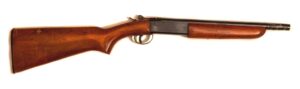
I have no firsthand experience with “Tokarev” shotguns and I do not want to. I have no need for crappy Turkish imports from some no-name brand wearing the face of a real person or company as a mask to hide its shame. Turkey makes some perfectly fine firearms, even including some of their shotguns, but at this price point, the level of quality is in my opinion so severely compromised as to make the cost savings totally illusory. If you want an inexpensive shotgun, just buy a Mossberg Maverick 88.
To Be Continued…
I realized late in the writing of this blog post that there are so many companies wearing the peeled faces of dead ones as grotesque skin masks, uh, with potentially misleading names, that I’d need to split it into two. One person I spoke to even joked that it’d be easier to list the companies that actually are what they say they are. Anyway, there’s no shortage of stories in the firearm industry of trademarks being passed around like baseball players the week before the trade deadline, so expect at least one more blog post on the topic. If there are any notable cases you’d like to see covered, drop me a line using the Stump My Nephew contact form (make sure you specify it isn’t a question for the show).