
It’s time to go through more results from my concealed carry survey, this time from the equipment section. As a reminder, the Great Concealed Carry Survey (okay, it isn’t exactly great, I’m just trying to make it sound more exciting) is still open. In fact, since my previous blog post a week ago, five more readers have responded, bringing the total number up to 72. Now that we’re getting into questions about what types of handguns people carry and where on or off their bodies they keep those handguns, I won’t be showing the exact results of some questions in the interests of anonymity and security.
Holster Style
This question asked, “How do you typically carry your concealed handgun(s)? Select all that apply.” Anecdotally, appendix carry (roughly 12:00 position) seems to be hugely popular these days, but mostly among younger guys. Nearly three-quarters of American adults 20 and older are overweight and more than two in five are obese, and to be blunt, the metabolic slowdown associated with middle age compounds that problem to leave, uh, less space for appendix carry. That and the fact that strong-side carry has been popular for much longer suggested to me that most people would be carrying strong-side. As a reminder, respondents were told to select all options that applied to them, which is why the numbers add up to more than 72. There were several other options you don’t see here, which I consolidated for the sake of both simplifying the chart and protecting the anonymity of respondents who use some of the rarer techniques.
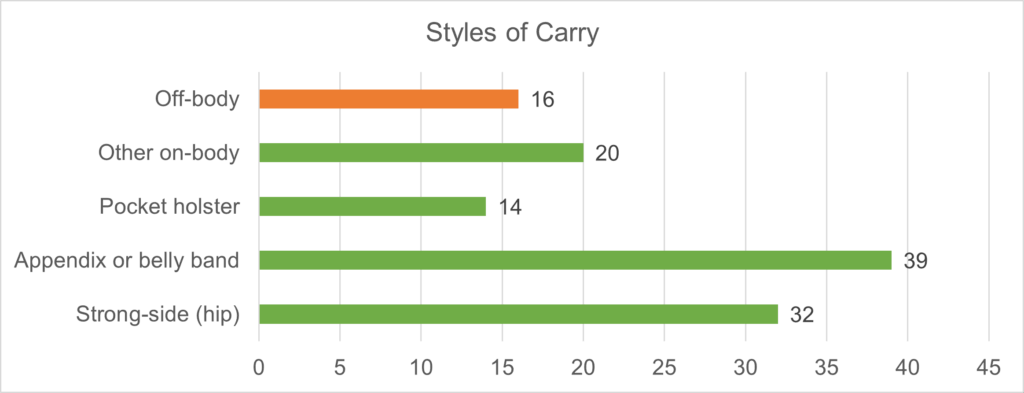
Color me surprised. As it turns out, appendix carry has “won” the debate over holster style, with around 54 percent of respondents using that style, followed by strong-side at a little more than 44 percent. To be honest, the trepidation I hear around appendix carry is largely unfounded. First of all, If you do not trust your gun to not have a negligent discharge, you should not be carrying it in the first place. Second, contrary to what some people claim, you absolutely can draw from an appendix holster while sitting down, though that may require adjusting your holster depending on the height at which you wear your pants. You don’t get to choose when a defensive scenario happens. You may find yourself behind the wheel of a large automobile, and in my admittedly limited experience, it’s actually easier to draw from an appendix holster while strapped in than from a holster around the 4:00 position.
Fortunately, only 22 percent of people carry off the body, such as in a purse, handbag, or backpack. I say “fortunately” because off-body carry is less secure. When I worked at the shop, my coworkers and I used two main arguments to drive this point home: First, what’s the likelihood of accidentally leaving a bag of some kind in a restaurant or on transit compared to something physically attached to your body or clothing? Second, if you’re walking down the street and happen to catch a thief’s eye, what’s the first thing of yours he’s going for? They’re called purse snatchers for a reason. Granted, some clothing (especially women’s clothing) lacks provisions for concealed carry, so for some people in some situations, off-body carry can become a necessity. I’ve even done it myself a couple of times because I didn’t have any proper holster appropriate for the way I needed to be dressed in those circumstances that wouldn’t leave the gun in plain view. I don’t think I’d go out and call off-body carry unsafe, just less safe than on-body.
One group of people I am willing to call out, however, is the roughly 4.6 percent of respondents who carry handguns loose in their pockets without pocket holsters. Please, please do not do this. Not only is the handgun held less securely, not only will the handgun’s outline be more easily distinguishable through your clothing, but you risk foreign objects finding their way into the trigger guard and causing a negligent discharge. It doesn’t matter if it’s a revolver with a 12-pound double-action trigger. Even if you don’t keep anything else in the same pocket with your handgun, it’s conceivably possible for the trigger to catch on the fabric itself, or on the corner of a piece of furniture you brush up against, for example. Again, do not carry like this.
Feed System
Genteel Yankee, charismatic podcaster, and friend of the show Charlie Cook recently confessed in front of me to “finally switching to a bottom-feeder” (a magazine-fed autoloader) due to his wheelgun’s alloy frame finally wearing out after two decades of hard use. Much to his chagrin, Charlie has joined the overwhelming majority.
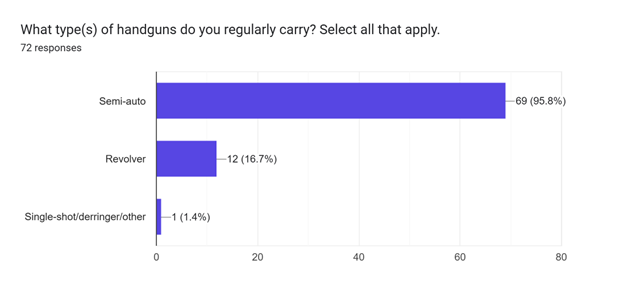
That’s 23 out of every 24 people carrying a semi-automatic pistol. Most people who carry a revolver with some regularity, myself included, switch back and forth between that gun and an autoloader. Keep that switching in mind.
By the way, which one of you is EDCing a derringer? I need to know who you are and why you do this.
Caliber
I won’t even bother including the chart here. 9×19 is absolutely dominant, boasting a share of 91.7 percent. In second place is .40 S&W at exactly one in six, then .38 Special at a little over 15.3 percent. At around 120 years of age, 9 mm has conclusively won the caliber wars. Get over it. Most people who carry other calibers also have nines they carry regularly.
I’m a little surprised that .40 boasts a 16.7 percent share to .45 ACP’s 12.5 percent given the latter’s long life, but perhaps I shouldn’t be. Most .45s are based on the 1911 platform, and clipping a two-and-a-half-pound block of steel to your belt every time you want to go to Wawa for a hoagie—sorry, In-N-Out for whatever it is you Californians eat—is highly inconvenient, especially with light clothing, not to mention bad for your lower back in the long term.
The .40 Smith & Wesson seems to be in its twilight years now, with major manufacturers discontinuing their guns that chamber it and used examples showing up used for half of what they went for new. Back in the ‘90s, when .40 was ascendant, one of the factors working in its favor was the nationwide 10-round limit on newly sold magazines. If you’re limited to ten rounds, the argument went, you’re better off with ten more powerful ones. I can’t help but wonder if the same logic still applies in California.
The most curious result of this question isn’t the popularity of 9 mm, the unpopularity of .380, the fact that four of you are rocking .22s, or even the one person out there carrying something in 5.7×28. It’s the fact that, despite 12 respondents carrying revolvers, there are 17 instances of revolver cartridges being carried. Unless there are that many people with Coonan .357 1911s in their concealed carry rotations, this means several revolver carriers are true fans who switch between multiple revolvers in different chamberings.
Number of Guns
I mentioned above that there are people switching between different holster styles and people switching between guns in different chamberings.
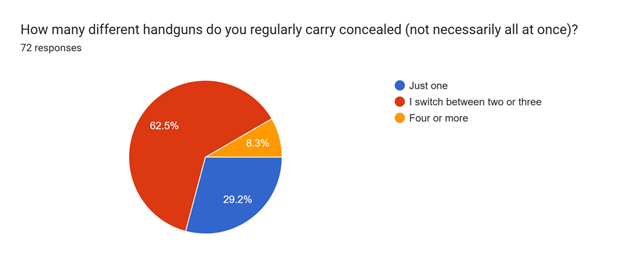
Unexpectedly (at least to me), a strong majority of people have two or three carry guns. I’d imagine the switching is based less on how a concealed carrier feels when he or she wakes up each morning and more on things like the weather (such as SoCal has any) and where the carrier plans to go. Gym shorts can’t take belts, so you’ll have to leave the bear gun at home and grab your micro nine or J-frame when you go out for a run.
As with previous results, I’m most interested in a small minority of responses. One in twelve respondents cycles through four or more different carry guns. I’m curious as to what kind of lifestyle encourages this behavior. Are these people routinely going places with wildly different climatic conditions? Do they have active social lives involving events with a variety of dress codes? I guess I could see it if you’re an office worker who’s also an avid outdoorsman and does a lot of yard work. I’m not criticizing, I just want to understand.
Accessories
Under the caliber question, I brought up the possibility of California’s idiotic laws impacting concealed carry decisions, and I suspect there’s even more of an impact here. 62.5 percent of respondents carry extra ammunition (implicitly at least one extra magazine, speedloader, or equivalent). Interestingly, tourniquets and trauma kits (40.3 percent) greatly outnumber weapon lights and/or laser aiming modules (26.4 percent) despite the fact that the latter being on the gun means it isn’t an extra thing you have to bring with you. A single-digit percentage of respondents carry backup guns. At 29.2 percent, fewer than a third of respondents carry just the gun and (hopefully) holster without any of those named accessories.