
As promised, this blog post will reveal and analyze results from the third part of my ongoing concealed carry survey. Before that, though, I have to point out that the most interesting result wasn’t in the answers to any of the actual questions, but rather the number of answers; In the two weeks since my previous blog post went up, the survey received a whopping thirty more responses, bringing the total up to 102! As a reminder, the survey is still live, so if you haven’t already, please take a few minutes to submit your own response and share the survey with your friends and family.
Like in the previous section, a few of the “Lifestyle and Usage Questions” are of a somewhat sensitive nature; even though my survey is totally anonymous, I will refrain from revealing some of the exact results in the interest of protecting respondents’ anonymity. By the way, for CYA purposes: I am not a lawyer, I am not your lawyer, and nothing in this blog post is intended as legal advice.
Is that a gun in your pocket, or are you just glad to see me?
Anecdotally, one of the greatest fears among new permit holders is that they’ll be “caught” carrying. In my humble opinion, though, although this concern has the benefit of promoting more responsible carry habits, it’s greatly overblown. The results support this:
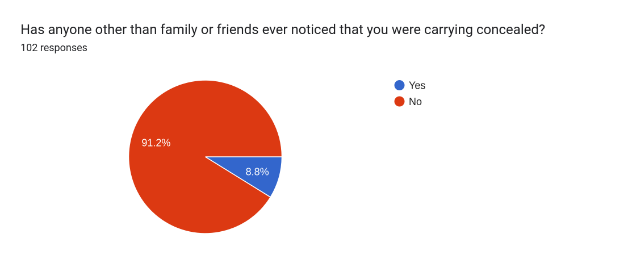
If you outfit yourself with a proper combination of handgun, holster, and hosiery, the only one who’ll notice you’re carrying is you. Paradoxically, your self-induced paranoia as an inexperienced concealed carrier will cause you to act awkwardly in public, which will draw attention to you, which in turn will draw attention to the fact that you have a gun on you. If you aren’t accustomed to carrying a concealed handgun and have some apprehensions about doing so, you can practice by carrying your gun loaded (without a round chambered, if you so desire) in its holster within your own home. You don’t need a permit to do that, and it’ll get you used to the feel. Once you begin carrying outside the house, there are a few basic points to keep in mind about the way you carry yourself to make sure you don’t make yourself conspicuous:
- Swing both arms the same way as you walk. Don’t keep your firing hand stationary by your side. For examples of what not to do, watch videos of Vladimir Putin walking (yes, really) and pay attention to his right arm.
- Don’t constantly adjust your clothing.
- Don’t pat your gun. It’s still there, I promise.
- Keep your shoulders relaxed and your hands out of your pockets.
- If you’re wearing an outer garment with an open front, keep it at least partially buttoned or zipped so it doesn’t blow or drag open to reveal your gun.
- Instead of bending over (for example, to pick something off the bottom shelf at a store), squat down. If you have to reach up, use your support arm.
Restricted Areas
This section’s second question asks, “Have you ever carried somewhere you shouldn’t have? Select all that apply.” The answer choices distinguish between places where we’re allowed to carry but not supposed to and places where we are not allowed. Why? Some states, including California, have laws that ostensibly empower businesses such as retail stores to disallow concealed carry on their premises. The way this works is that the business must post a clearly visible sign with specific wording referencing the relevant part of the California penal code, then if someone is caught carrying on the premises, the property owner or manager must order the person to leave or face a trespassing charge. Consequently, what these types of laws really do is create a new justification to kick people out. I won’t get into the argument about whether this constitutes lifestyle-based discrimination here, but the important thing to know is that the SB2 “no guns allowed” signs, despite citing law, have no force of law until you are asked to leave because you are carrying a gun. You are allowed to carry in these types of “gun-free zones” until told otherwise.
About 46 percent of respondents have carried a concealed firearm somewhere they were “legally allowed to but would have gotten in trouble if caught” (emphasis not in the original). Given GOR’s California-centric nature, this suggests most people ignore “gun-free zone” signs, meaning that legal provision has little effect. Remember, the whole point of concealed carry is that no one knows you have a gun, and people who intend to harm others don’t ask for permission first. The person sitting next to you on the bus or in a restaurant could be carrying illegally and no one would have any way of knowing, let alone doing anything about it, unless we had metal detectors in every doorway and armed police officers stopping and frisking random people.
Given that barely more than a third of respondents reported never carrying anywhere they either weren’t allowed to or weren’t “supposed to,” there are in fact more law-abiding citizens, let alone criminals, ignoring “gun-free zone” signs than following them.
How do people deal with “gun-free zones?”
In addition to their unenforceability, “gun-free zones” create a glaring safety hazard. Before entering such a location, each concealed carrier is faced with the choice to either break the property manager’s rules, leave his or her firearm unattended, or waste time driving home to drop the gun off.
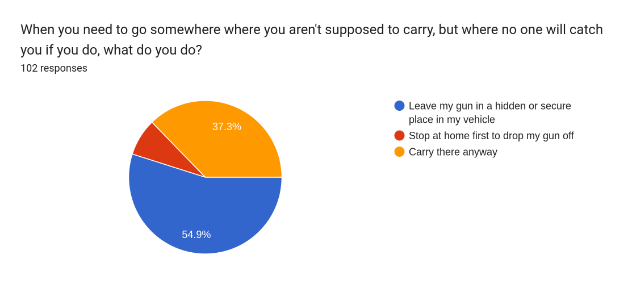
About 37 percent of respondents, slightly fewer than two in five, choose the first option. As mentioned above, the whole point of concealed carry is that no one knows you have a gun on, so this result should come as no surprise. Most people apparently leave their guns unattended in their vehicles, and only eight percent or so take the time to be both safe and compliant.
Suppose you’re the owner or general manager of a retail establishment or other public-facing business and you have the option of posting a “gun-free zone” sign in your front window. The choice you’re really making is as follows:
- If you don’t post the sign, nothing happens. Concealed carriers are statistically very law-abiding, so you’re essentially getting a slight added measure of physical security for free.
- If you post the sign, two in five people will ignore it and half will turn their cars in your parking lot into treasure chests for petty thieves. A criminal who breaks into one of those cars might well be treated to a free gun.
Defensive Situations
With concealed carry, here’s where the rubber meets the road. We spend all this money and time to make sure that if the worst happens, we and the people around us won’t become victims. I’m sure I speak for all of us when I say we dread being put in a defensive situation, but we’re glad we have the ability to protect ourselves and others. How many of us, though, have ever had that fear realized?
Before the survey, I would have guessed that roughly one in ten concealed carriers has ever had to draw his or her gun, and that about a third of those people actually had to fire a shot. What do the results say?
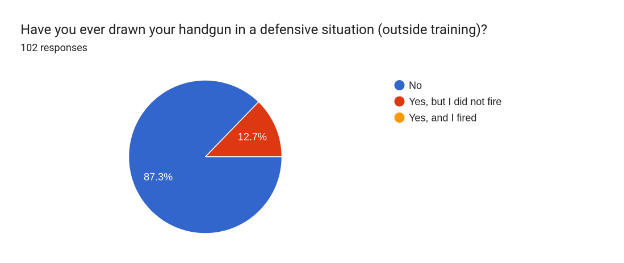
About one in eight. That’s slightly higher than I expected going in, but by far the more interesting result is that not a single respondent had to fire a shot. That’s a good thing! It means the mere sight of the firearm is enough to deter a would-be assailant from turning the situation violent.
Hard numbers are hard to come by, but I’ve seen people on the pro-gun side quote an estimate that somewhere between 1 million and 2.5 million defensive engagements occur in this country in each year in which the potential victim doesn’t fire a shot. John Lott’s CPRC estimates there are around 20.88 million permit holders in the U.S. as of 2025; applying our 12.7 percent figure to his gets us a derived estimate in excess of 2,650,000 non-shooting defensive engagements per year, slightly more than the high end of the popular estimate.
What about the counterfactual, though?
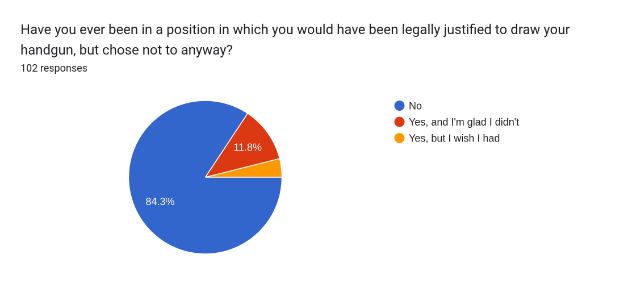
I won’t devote too many words to this one, but suffice it to say, most people have had the good fortune of not being in a potential defensive scenario. With the reflection that time allows, most people who could have drawn their guns but chose not to acknowledge that they made the right call in the moment.