

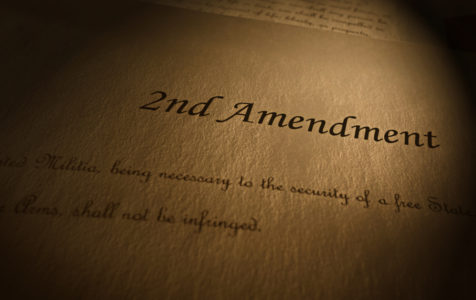
The Second Amendment is brief—just 27 words—but its meaning has been misunderstood and debated for centuries.
“A well regulated Militia, being necessary to the security of a free State, the right of the people to keep and bear Arms, shall not be infringed.”
Well regulated
Historical sources, including Webster’s 1828 dictionary, define “well regulated” as trained, disciplined, and properly functioning. A defensive force that lacks arms or training cannot be “well regulated.” This reflects a moral principle: caring for community safety requires those tasked with defense have the capability to defend themselves and others.
Too often, people claim the Second Amendment grants a right to arms only within a government-controlled militia. That interpretation is historically and logically flawed. The words make clear that a militia can only exist if civilians are first equipped with suitable weapons to participate. If citizens are disarmed and cannot own the arms it takes to act as a militia, there is no militia to defend your family and country.
Militia
At the time of the founding, a militia was composed of the able-bodied populace who came together for community defense. The Framers envisioned ordinary citizens, not a professional army, as the foundation of peace and security. Up until that time in history, a standing army was also tasked with enforcing the will of a king or emperor. Fairness demands that if society expects its citizens to help defend life and liberty, it cannot deny them the means to do so. Scholars such as David Kopel note that the early American militia depended on citizens bringing their own “military-grade” weapons, emphasizing that the right to keep and bear arms precedes and enables the militia itself.
The American experiment was to be the country of the self-governed and a militia is far less likely to abuse citizens at the command of a ruler. Choosing to codify a “well regulated militia” over a standing army is right in line with a country of the self-governed. The choice to fund a standing army and limit it with posse comitatus does not change the Framers’ intention,nor does it change the possible need of a “well regulated” militia.
Necessary
The word “necessary” carries a crucial meaning that was chosen deliberately to show that a well-regulated militia—and by extension, the people’s right to keep and bear arms—is not optional or merely useful, but essential to the preservation of a free state. By declaring a militia “necessary to the security of a free state,” the Amendment establishes that self-governance and security cannot exist without an armed populace capable of self-defense. In this context, “necessary” means that disarming the people would not just weaken national defense—it would eliminate the very condition that allows liberty to survive, opine, and determine the conditions for the life they envision.
State
“State” is the collective body politic, the people united under government, according to Webster. This meaning is confirmed in Black’s Law Dictionary (9th edition), which defines “state” as a political entity composed of people under a common government. The right to self-defense is not an individual luxury—it is integral to the protection of the entire community. The use in the Second Amendment is not referring to the individual states of the newly formed United States, rather, it refers to the entire United States combined.
Right
The Amendment affirms “the right of the people to keep and bear Arms.” A right is a natural endowment from God or nature. The right to keep and bear arms is not given by government, otherwise we would call it a privilege, and it making the right to self-defense possible. By prohibiting the most effective means of self-defense, you are denying the very right to self-defense.
Keep and Bear Arms
“Arms” is the word most often debated. Webster’s 1828 dictionary defines “arms” as tools of defense: muskets, bayonets, cartridge-boxes. These were ordinary weapons, not exotic tools for elites. To infringe on this right, the text warns, is to break or hinder it, leaving citizens vulnerable.
The Framers defined “arms” as the weapons necessary for self-defense and participation in a militia, including muskets, bayonets, cartridge-boxes, and similar tools, but not exotic or specialized equipment (Webster’s 1828 Dictionary). In practice, this meant ordinary citizens were expected to supply themselves with the weapons needed to serve effectively in a defensive force (Kopel, The Second Amendment Primer, 2001).
The arms you need to effectively and reasonably defend yourself against an attack are the arms you have the right to own. Civilians who rose up against the British in the 1700s acquired cannon, warships, and fought with rifles that were far more effective than the British muskets. For a militia to be “well regulated,” civilians need arms suitable for organized defense, ensuring the security of both community and state.
Infringed
“Infringed” is deliberate and strong. According to Webster, “infringe” means to violate, hinder, or destroy—emphasizing the seriousness of any attempt to limit a natural right. The phrase “shall not be infringed” in the Second Amendment was intended by the Framers to prevent any government—federal or state—from violating the pre-existing natural right of individuals to keep and bear arms. In United States v. Cruikshank (1876), the Supreme Court affirmed that this right was not granted by the Constitution but existed independently, emphasizing that “the Second Amendment declares that it shall not be infringed; but this… means no more than that it shall not be infringed by Congress.” Justice Joseph Story, in his Commentaries on the Constitution of the United States, echoed this sentiment, noting that the right to bear arms was “the palladium of the liberties of a republic,” underscoring its fundamental nature. “Infringed” was understood to mean any governmental action that would diminish or violate this inherent right, reinforcing the Framers’ intent to protect individual liberty against governmental overreach.
In 27 words, the Second Amendment captures a timeless truth: a free society depends on capable, armed citizens. The very nature of the Second Amendment puts trust and faith in you and your self-determination. Care and fairness demand that the people be trusted with this natural right—not restricted to government-controlled forces, but preserved for the protection of themselves, their communities, and the state itself. Understanding these words is not an abstract debate; it is a moral imperative for safety, responsibility, and justice.