
The National Rifle Association Annual Meeting (NRAAM) is a peculiar event. Its main purpose is, as its name implies, to bring the board members together to elect the CEO, determine committee assignments, and make other governance decisions to keep the organization running. NRAAM is also something of a professional conference, with seminars in which pro-2A activists from across the country meet and compare notes to help coordinate the fight for our constitutionally protected right to keep and bear arms. What most people know about NRAAM, though, is its exhibition floor, second only to SHOT in scale and prestige among firearm industry trade shows. Anyone who’s anyone is there: heavyweight gunmakers such as Springfield, Ruger, and PSA; specialists such as Mec-Gar, Samson Manufacturing, and Berry’s Bullets; and a surprising miscellany of others, including nonprofits and white-label OEMs. The Gun Owners Radio booth on “Media Row” sat adjacent to that of a company selling garden tools. I can’t even laugh at that, either, because they looked like genuinely good garden tools!
Most of the firearms and firearm accessories on display in Houston this year were examples of extant or revealed-but-not-released products, but a few companies timed new product announcements for the show. With 14 acres of guns and gear to look at and only three days to do it, I’m sure I missed a few hidden gems, but here are a few of the most interesting products I saw at NRAAM. Not all of these are new, but all of them are distinctive enough to warrant a mention.
Most Interesting Firearm: Genesis GEN-12
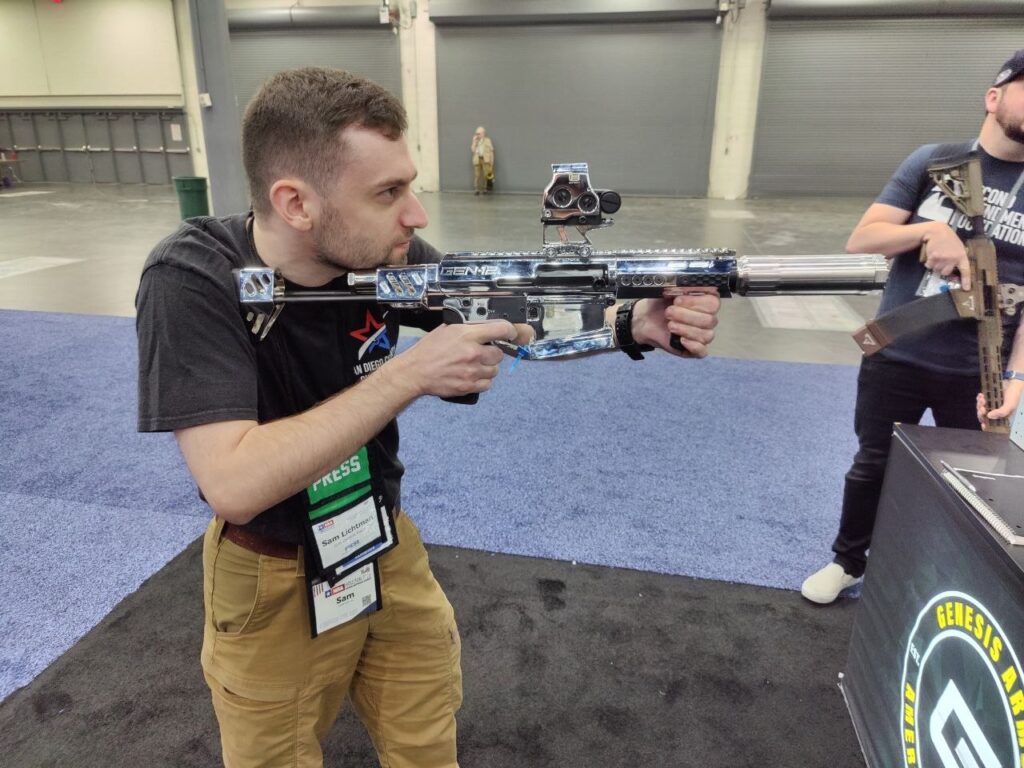
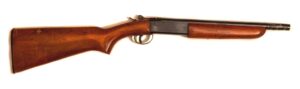
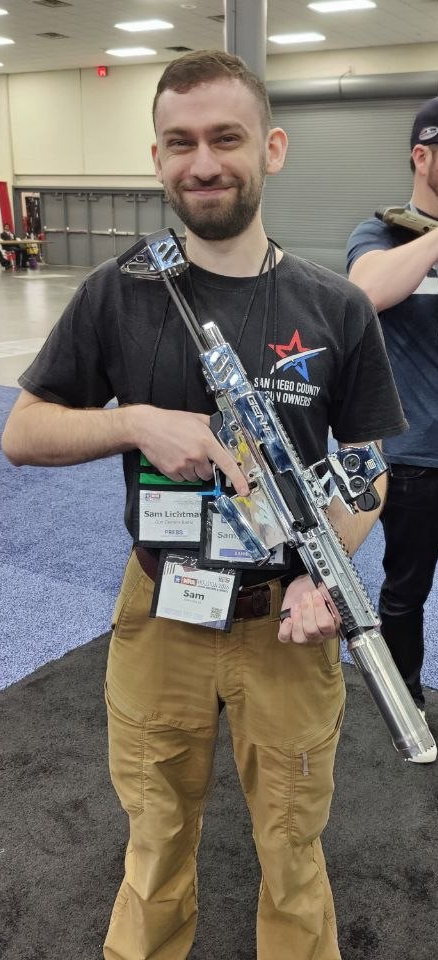
Some of the guys from GOAL, the hardworking affiliate organization fighting for the Second Amendment in Massachusetts, were eager to check out the semi-automatic 12-gauge shotguns made by Genesis Firearms. I don’t have any use for one of these AR-style firearms on the trap range, especially with how short their barrels are compared to that of my trusty Winchester 1200, and I certainly can’t afford the eye-watering nearly $2,900 price tag on the most “basic” configuration, so I was about ready to poke fun at what I saw as ostentatious conversation pieces.
Imagine my surprise, then, when one of the Genesis Arms reps explained that the company has programs of record with the Coast Guard and USSOCOM to provide short-barreled GEN-12s for use in visit, board, search, and seizure (VBSS) operations and other specialized use cases. With a true plethora of options in birdshot, buckshot, and hard-hitting slugs, 12 gauge is already the most versatile chambering of any civilian firearm. In military and law enforcement use, though, the humble 12 gauge boasts an even wider repertoire, including breaching slugs, less-lethal projectiles, teargas rounds, and even grenades, just to name a few. In the close confines of a ship or building, the ballistic disadvantage from a shorter barrel is much less pronounced, and the tremendous muzzle blast is tamed by a suppressor.
Additionally, with the proliferation of small UAS in recent years, various semi-automatic shotguns including the GEN-12 have gained new life on the modern battlefield and have already proven their worth in Ukrainian hands. To that end, the U.S. military has apparently conducted some testing with the GEN-12 to investigate its performance as an anti-drone weapon for infantry squads.
The recoil-operated GEN-12 is compatible with AR-style pistol grips and adjustable stocks and is available with 2-, 5-, 9-, and 19-round box magazines. Obviously, those features make it heavily restricted in several states, my own soon among them, and I don’t see much of a use case for the GEN-12 in civilian hands, but the fact that such a seemingly impractical weapon is invaluable in military use earns it the title of Most Interesting Firearm of NRAAM 2026.
Most Interesting Optic: InfiTac OWS-32 Waveguide Sight
In a perfect world, you could have a non-corporeal reticle pop up, floating around in your field of view, that centers exactly on whatever your firearm is pointed at. The closest we can practically get to that ideal is what many people call a “red dot sight,” a term I dislike due to its vagueness and inaccuracy. What people are talking about when they use that term are reflex sights and holographic sights, the relative advantages and disadvantages of which I covered in my “Introduction to Optics” series back in 2024. Reflex sights are generally better for most use cases: As a general rule, they’re cheaper and lighter, have at least an order of magnitude better battery life, and come in a huge variety of models with different lens sizes and feature sets to meet any need. Their biggest drawback is that, if you have enough of an astigmatism (a common structural deformity in the eye), a reflex sight’s reticle will appear as a smear, a streak, or a starburst instead of a sharp dot. Holographic sights, though, tend to be heavy and expensive, and are notorious for their aggressive battery consumption. The only real options on the holographic market are the EOTECH HWS line, the Vortex AMG UH-1, and the relatively unproven DOT EHS-1.
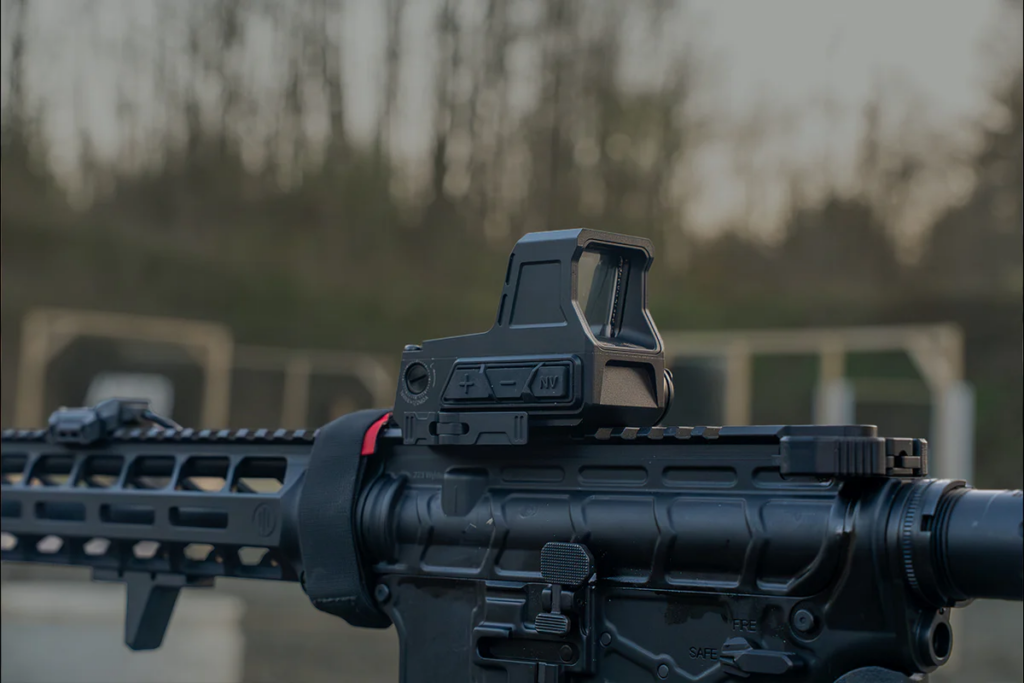
At NRAAM 2026, Texas-based optics company InfiTac showed off its new OWS-32 optical waveguide sight. It works in a completely different way from either reflex sights or holographic sights, using something sort of like a large, rectangular optical fiber (the eponymous optical waveguide) sandwiched between two panes of clear glass to display the reticle. In terms of features and functionality, the OWS-32 looks a lot like a holographic sight. Unlike reflex sights, the OWS-32 has no tint whatsoever and minimal optical distortion; the company advertises it as parallax-free, a bold statement with which I at least mostly agree. In combination with the perfectly clear glass, the relatively large window contributes to a difficult-to-describe sort of “panoramic” feel.
The OWS-32 boasts an impressive feature set: multiple reticles, auto-off/shake-awake, automatic brightness, and night vision compatibility with no downrange signature. InfiTac claims an IP67 rating, which means the sight should be dustproof and watertight (though maybe not enough for prolonged submersion). Like an EOTECH HWS, the OWS-32 is still usable even with broken glass, but like an EOTECH HWS, it’s relatively heavy at 9.9 ounces and only has an advertised battery life of 1,500 hours on a standard CR123A battery. Unlike an EOTECH and more like many low-end reflex sights (I’m looking at you, Vortex!), the OWS-32 unfortunately exhibits some PWM flicker at low brightness settings. For the uninitiated, this means that they way InfiTac achieves brightness adjustment is by rapidly turning the internal light source on and off too quickly for the human eye to perceive unless the reticle is moving. When swinging the rifle between targets, though, especially in low-light conditions, the flicker becomes distracting.
Through a magnifier, the OWS-32 behaves more like a reflex sight than like a holographic: The reticle is magnified along with the background scene. This means that a BDC reticle’s subtensions will still be correct under magnification, and one of the reps told me they are indeed working on a BDC version. A magnifier also makes more apparent the frankly astonishing sharpness and crispness of the reticle. To my eye, most reflex sights other than those from Aimpoint have slightly fuzzy reticles, like they’ve been drawn on paper with a dull pencil or a marker that bleeds ever so slightly. A holographic sight’s reticle looks sharper, but it also looks like it’s made of a collection of tiny dots. The OWS-32’s reticle, by contrast, looks pretty much flawless to me. The limbs of the crosshair reticles look like perfect rectangles, the center dot looks like a perfect circle, and so on.
InfiTac’s reps told me the OWS-32 is supposed to hit the market this month (May 2026) for a price of around $500. It isn’t a good idea to immediately go out and buy an unproven product based on one man’s anecdotal experiences handling one example on the floor of a trade show, so don’t take this as a recommendation. Wait for reviews from serious shooters who put their gear through hard use before you make a decision. I know I’m interested, though, if only because this thing has totally different internal workings from anything else in its category. The OWS-32 is certainly cool enough to earn the title of Most Interesting Optic of NRAAM 2026.
Most Interesting Accessory: CompMag
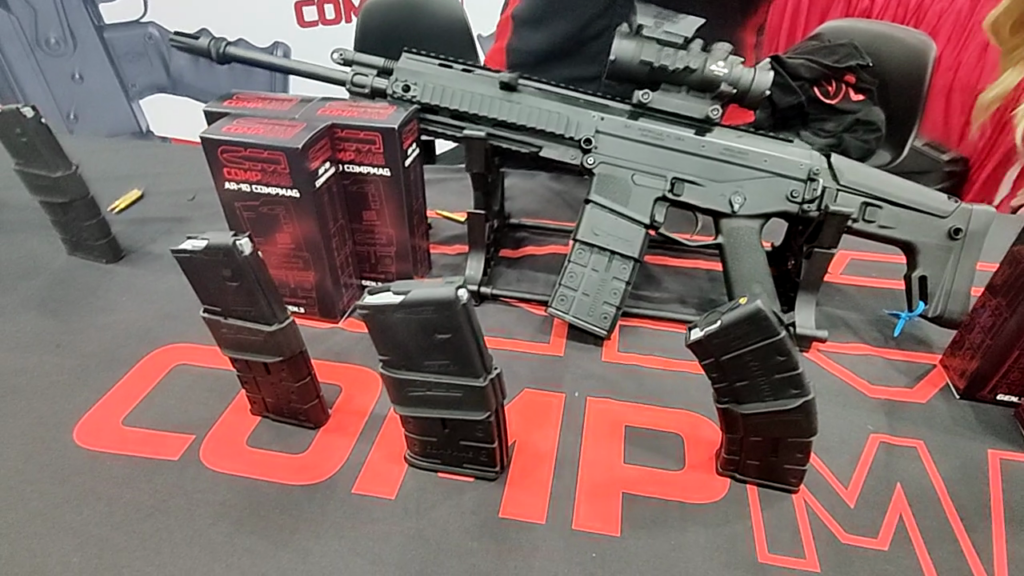
It’s easy to go around saying “all gun laws are infringements,” and I won’t get into the ethics of violating unconstitutional laws in this post, but as a matter of practicality, it helps to have compliance options. After all, even if you thumb your nose at your state’s hardware bans, you can be confident that there are LEOs at your local range who would just love to earn their meal tickets by locking you up for having a barrel that’s half an inch too short.
Hardware bans generally have qualifiers and a feature list. Part of California penal code § 30515 defines an “assault weapon” as “a semiautomatic, centerfire rifle that does not have a fixed magazine [the qualifiers] but has any one of the following [the feature list].” To that point, there are basically four ways of neutering an AR, AK, or similar to make it California-legal: Make it not semi-automatic, make it not centerfire, give it a fixed magazine holding no more than 10 rounds, or get rid of the features. One popular compliance option on the Kali Key, which replaces an AR-15 or AR-10’s gas key and charging handle to convert the rifle to straight-pull bolt-action operation. At NRAAM, I saw a second one that maintains your rifle’s semi-automatic functionality: the CompMag.
CompMag makes a ten-round magazine (actually three of them, an AR-15 version, an AR-10 version, and an AK-47 version) that cannot be removed from the firearm in which it is installed without disassembling the firearm. To install, just insert the magazine the way you would any other. It locks in normally, but manipulating the magazine catch doesn’t release it. To remove the CompMag from an AR, you need to open the receiver, open up a little access panel on the top of the CompMag, and use a tool to remove it from above. For states with even more restrictive bans, like Virginia is about to be, that panel can be glued shut to make the CompMag impossible to remove without drilling into it, which of course destroys it. To load the magazine, pull down on an exposed tab and push it into a notch to lock the follower in a depressed position (like locking the bolt of a STEN or MP5 to the rear). Then, open the door on the left side of the magazine body and drop the rounds in. Finally, close the door and release the follower.
The reason I call out the CompMag is interesting is because it’s the easiest and cheapest way of which I’m aware to bring compatible firearms into ban compliance. Nothing is permanently modified, you get to keep all your features, and unlike the Kali Key, the rifle retains its semi-automatic action. It’ll still handle exactly like you’re used to, just with a slower and more convoluted reloading procedure. To be blunt, yes, it sucks that this product is even necessary. The $65 price of one CompMag to neuter one AR-15-type rifle could instead go into something like five 30-round PMAGs. If you want your firearm to be able to see the light of day, though, I can’t think of a better option. That’s why, from the resident of a ban state in the making to the residents of the most infamous ban state of them all, I’m calling the CompMag the Most Interesting Accessory of NRAAM 2026.
Most Interesting Piece of Gear: ATI Iron Lady
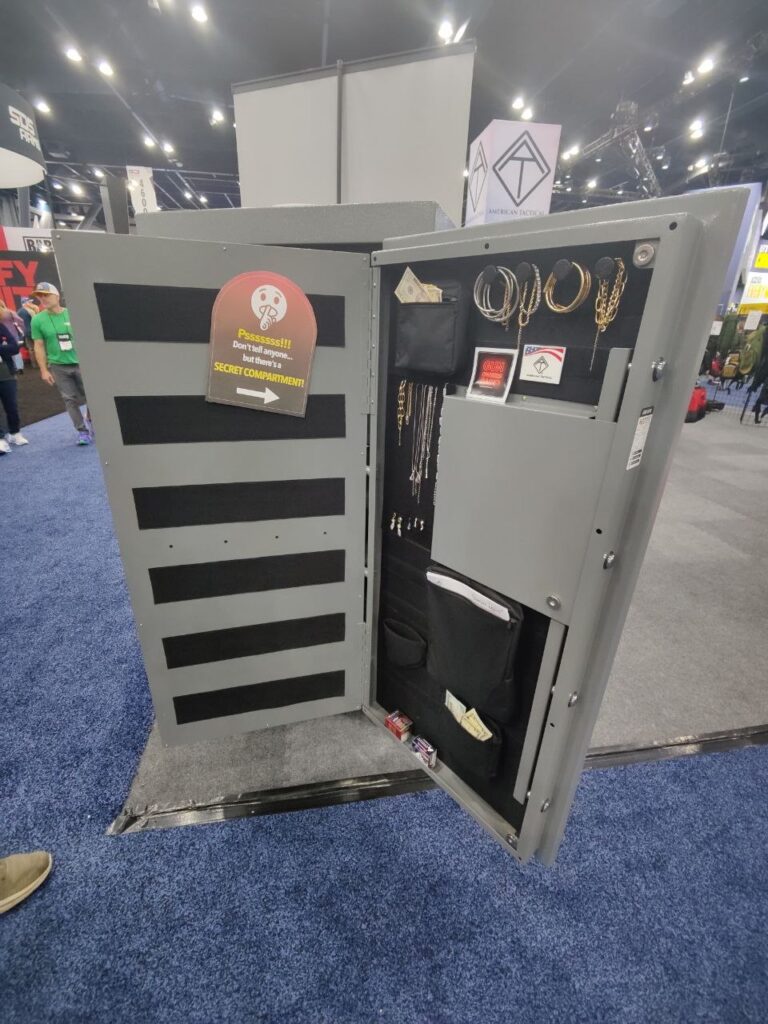
Ah, American Tactical. Manufacturer, importer, distributor, and dealer of a huge variety of guns and gear. From my time working at a gun store that used ATI as a dealer, I think of them as sort of the Walmart of the gun world, offering a mix of crappy Turkish shotguns and Chinese soft goods alongside genuinely good products at reasonable prices. A new member of the latter category on display at NRAAM 2026 was the Iron Lady, a line of sub-$1,000 upright gun safes.
The Iron Lady is pretty much just a normal gun safe at a competitive price. It’s felt-lined and comes with modular internal shelves and pouches on the door for extra storage. Externally, it uses a keypad for entry, a feature I much prefer over the fancier biometric offerings on the market. Protective features include raised feet for flood safety, four internal crossbolts to secure the door, and resistance to temperatures up to 1,200°F. None of that is any big deal, even for an affordable safe such as this one (well, these ones, as you can get it in two sizes). What is a big deal is the hidden compartment inside the door. The interior door panel looks just like that of any other gun safe, and even has fake rivets around its perimeter to subtly complete the illusion, but it’s actually only secured to the rest of the door by strong magnets. Pry it open to gain access to a hidden compartment with more storage pouches, presumably intended for jewelry, precious metals, or any other small objects you consider much more valuable than the long guns in the safe’s main body.
In my mind, the hidden compartment probably isn’t all that useful for the fact that it’s hidden; if an unauthorized person can gain access to the inside of your safe to begin with, you’re already pretty well screwed. I see its utility more for its extra storage space, regardless of the fact that you’d have no way of knowing it’s there unless you already knew. I, for one, am bad at keeping myself organized, so more vertical surfaces with pouches inside a typically sized safe certainly isn’t a bad thing. I can easily imagine using the hidden compartment to store several handguns, extra magazines, and boxes of ammunition. If you’re an “out of sight, out of mind” kind of person, it might be more useful as a place to keep specialized tools, spare parts, manuals, and other items you rarely use but want easy access to. Be advised, if you decide to buy one of these safes, you will need to either go through a stocking dealer in your area or contact ATI directly, as they apply a blanket “sale not allowed in California” tag to every product on their consumer-facing website.
Regardless of its actual utility, the sheer novelty of a hidden compartment inside the safe’s door, which is otherwise wasted space, brought a big grin to my face when I saw it. Even without that feature, though, $980 for the 32-inch-wide model and $850 for the 26-inch-wide model aren’t bad prices for upright gun safes. I feel it’s warranted to call the ATI Iron Lady the Most Interesting Piece of Gear of NRAAM 2026.