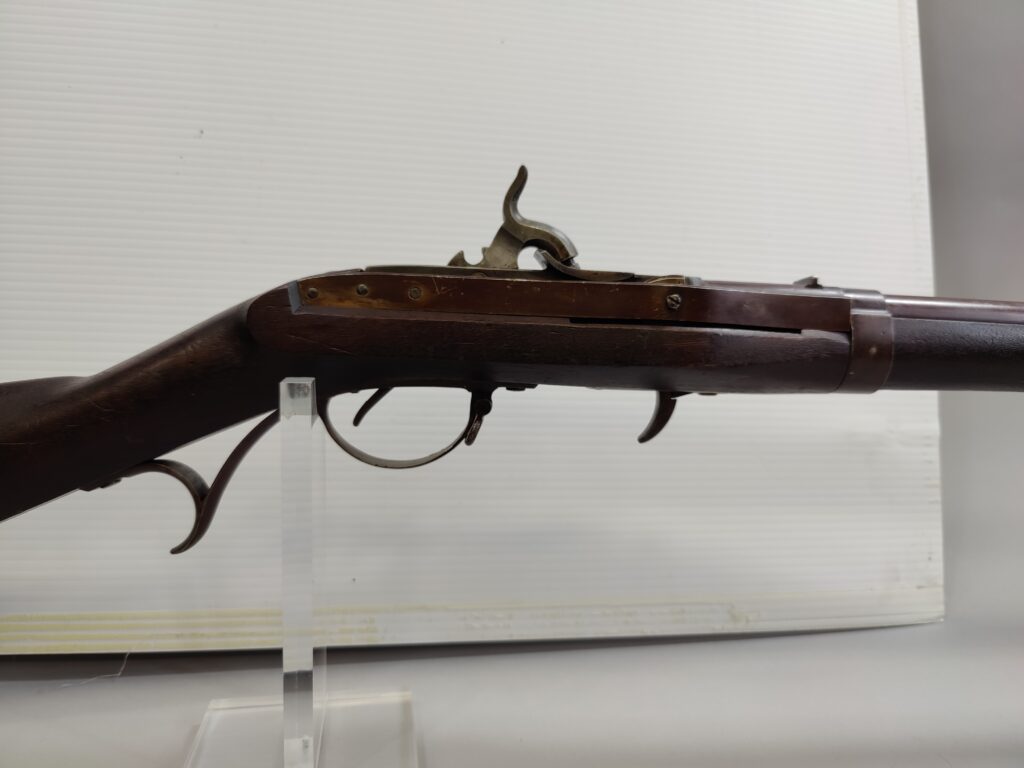

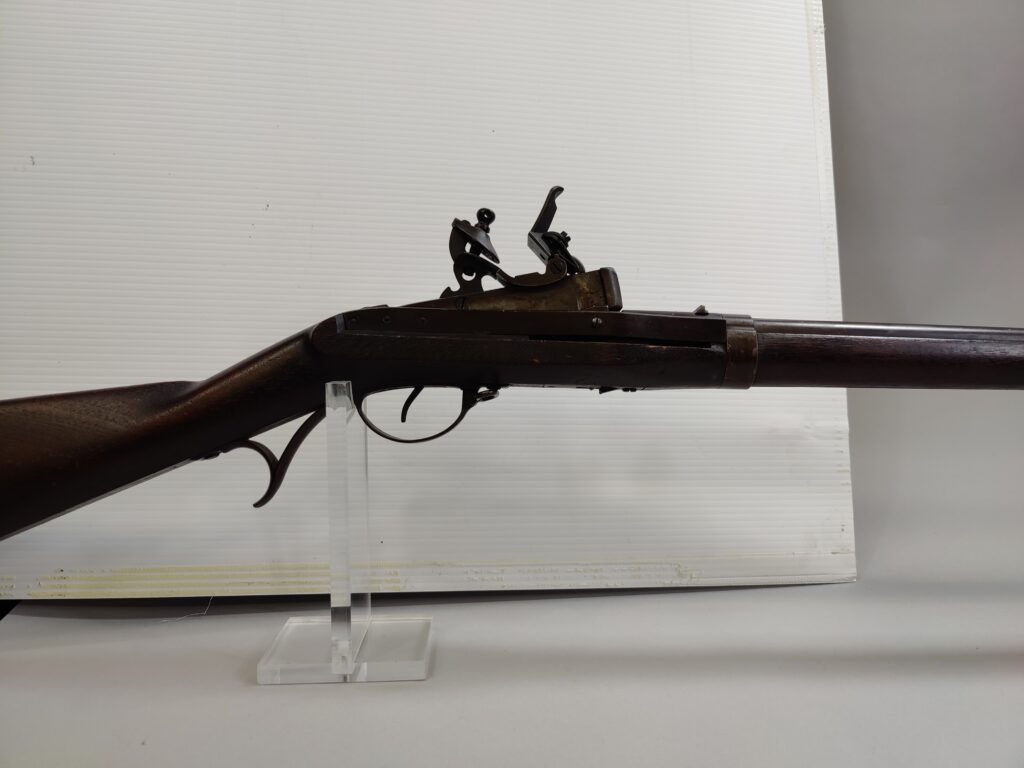
Author’s Note: This blog post is adapted from a short piece I wrote for the January 2025 issue of Leatherneck, Magazine of the Marines. It is part of a series of briefs on historic long arms, commemorating the Marine Corps’ 250th anniversary year.
Technical Data
Weight: 10 lb. (approx.)
Overall Length: 52 5/8”
Barrel Length: 32 5/8”
Chambering: .52 or .58-caliber
Feed System: tilting chamber
Operating System: flintlock or percussion
Rate of Fire: 9 rounds per minute effective
Range: 1,150 yards maximum
Description
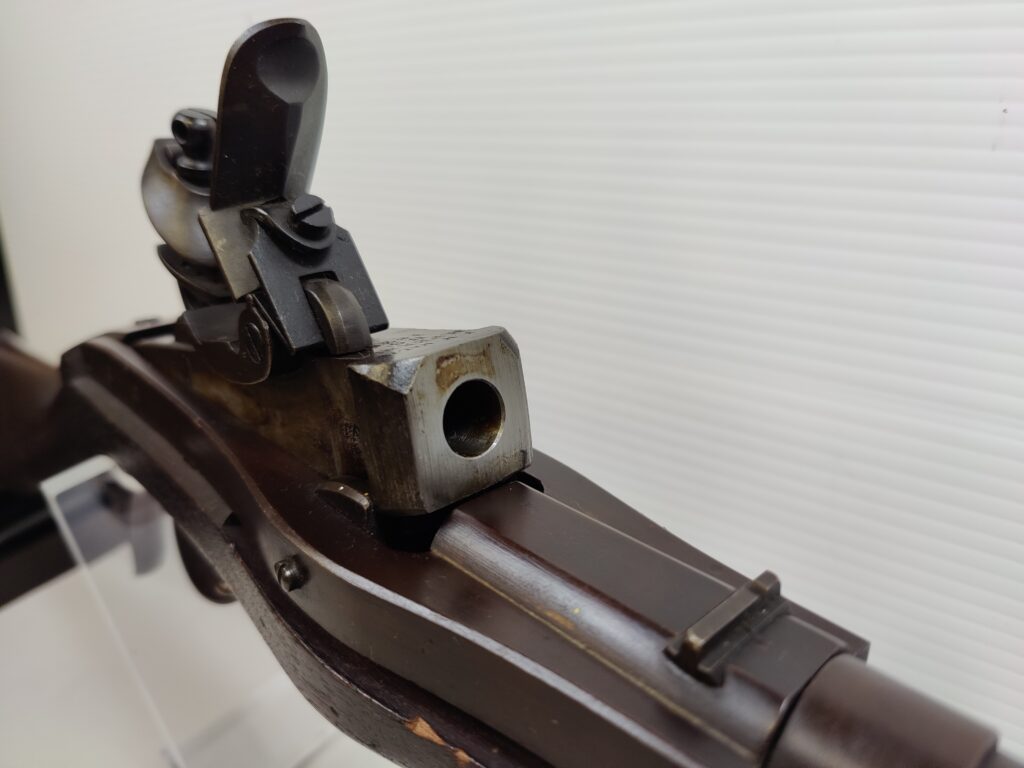
Although references to the tip-up chamber and other breechloading mechanisms exist as early as 1664, the M1819 Hall rifle was the first breechloading long arm used in the U.S. military. A latch forward of the trigger guard allows the shooter to tilt the chamber upward, at which point he can load it with powder and ball or a paper cartridge. After locking the chamber in its downward position and cocking the hammer, the Hall rifle is ready to fire. Whereas a muzzleloading musket must be loaded from a standing position, a trained soldier or Marine could load his Hall rifle while prone, sitting, or kneeling, and do it three times faster. The speed advantage was even greater relative to contemporary rifles, which were even slower to load than smoothbores by virtue of their rifling creating resistance when ramming the ball down.
Development and Service History
In 1814, John H. Hall of Portland, Maine, demonstrated prototype breechloading flintlock rifles based on his patent of three years prior. The War Department was suitably impressed, ordering 100 examples for further testing in 1817, then two years later, awarding Hall a production contract. Under his direct supervision, the armory at Harpers Ferry, VA, produced M1819s through 1840, though in relatively small numbers due to their cost and complexity. To enable manufacturing of the highly advanced design, John Hall developed tools and gauges which allowed for much greater precision than was typical for the time. Despite this, however, existing technology could not fully solve the problem of gases leaking from the gap between chamber and barrel. Throughout their service history, which included the Seminole Wars, Hall rifles were always used in smaller numbers than conventional muskets, though many were converted from flintlock to percussion after the latter system’s adoption in 1842. Converted Hall rifles saw action in the Mexican-American War (1846–1848) and persisted in small numbers through the Civil War. Of some note, the West Virginia Senate adopted a resolution in 2013 making the M1819 the state’s official firearm.