
As we revel in the pro–Second Amendment movement’s greatest victory since, well, ever, now is as good a time as any to consider how we arrived at this point. Silencer Shop Foundation v. ATF may well be the last NFA court case we ever see, so let’s take a look at one of the first: U.S. v. Miller. It wasn’t the first Supreme Court case about the NFA—as far as I’m aware, that distinction is held by Sonzinsky v. United States (1937), which concerned dealer registration fees—but it was the first to involve the NFA’s hardware restrictions, including the ones which were recently eliminated.
First, some background for those readers who may not understand how the National Firearms Act of 1934 worked. It’s a part of the tax code which created various categories of firearms and subjected some of them to special restrictions. Namely, to manufacture or receive an example of a restricted type (short-barreled shotgun, short-barreled rifle, “silencer,” “machinegun,” “destructive device,” or “any other weapon”), a tax had to be paid. Additional paperwork was required, which could in some instances take more than a year to process, and the owner of the item had to keep a special stamp with it certifying that the tax had been paid and the item registered.
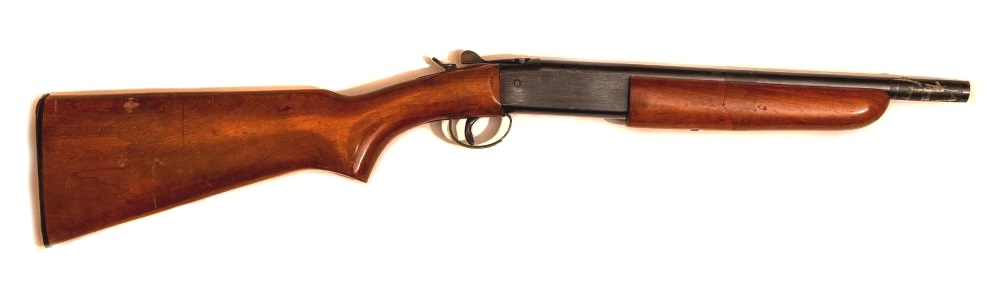
To paraphrase the common legal adage, bad case facts make bad case law, and Miller is a star example. Jack Miller and Frank Layton were gangsters who were caught transporting an unregistered short-barreled shotgun (a 12-gauge Stevens double-barrel, in this case) from Oklahoma to Arkansas. After a lower court overturned Miller’s conviction and the NFA itself as unconstitutional, the case made its way to the Supreme Court. The case was set to be argued on March 30th, 1939, and was decided on May 15th. I say “set to be” because Miller’s attorney couldn’t raise the funds to travel to Washington, D.C., and thus did not appear to argue the case. Between arguments and the decision, Miller himself was shot dead; Layton, for his part, had already pled guilty and been sentenced.
From the Supreme Court’s 8–0 decision, we have some idea as to the nature of prior arguments in Miller’s favor. The main thrust seems to have been that the NFA itself was “not a revenue measure but an attempt to usurp police power reserved to the States.” The court addresses this complaint by referring to Sonzinsky, in which it had already decided that, because the NFA imposes taxes for certain activities and criminal penalties for failing to pay those taxes, the NFA falls within Congress’ Article I, Section 8 power to levy taxes. The decision cites five other cases regarding the Harrison Narcotic Act to reinforce that Congress using its power to tax does not constitute a usurpation of the states’ police power.
With the taxation issue out of the way, most of the Miller decision covers the argument that taxing short-barreled shotguns violates the Second Amendment. To quote Justice McReynolds’ unanimous decision directly: “In the absence of any evidence tending to show that possession or use of a…[short-barreled shotgun] has some reasonable relationship to the preservation or efficiency of a well regulated militia, we cannot say that the Second Amendment guarantees the right to keep and bear such an instrument. Certainly it is not within judicial notice that this weapon is any part of the ordinary military equipment or that its use could contribute to the common defense.”
The next sixteen paragraphs go on to address the relationship between the text of the Second Amendment to the history and tradition of militias and the militia system before and after the founding. The Supreme Court’s view in Miller was that, based on the “history and legislation…and the writings of approved commentators,” it is abundantly clear “that the Militia comprised all males physically capable of acting in concert for the common defense…bearing arms supplied by themselves and of the kind in common use at the time.”
After quoting a variety of historic sources concerning what a “well regulated Militia” was understood to mean in 1791, the court concludes that, while states had by that point passed various laws implicating the right to keep and bear arms, none of those appeared to offer any alternate interpretation of the Second Amendment that would support Miller’s claims. Miller himself was dead, the Supreme Court did not overturn the NFA, and short-barreled shotguns and other types remained restricted. Though modified by later gun control laws, the NFA’s taxation and registration system remained wholly intact from 1934 until 2026. In an upcoming blog post, I will point out some parts of the Miller decision I think bear more examination and discussion, even in the wake of the NFA’s (partial) demise.