
Author’s Note: This blog post is adapted from a short piece I wrote for Leatherneck, Magazine of the Marines. It was part of a series of briefs on historic long arms, commemorating the Marine Corps’ 250th anniversary year.
Technical Data
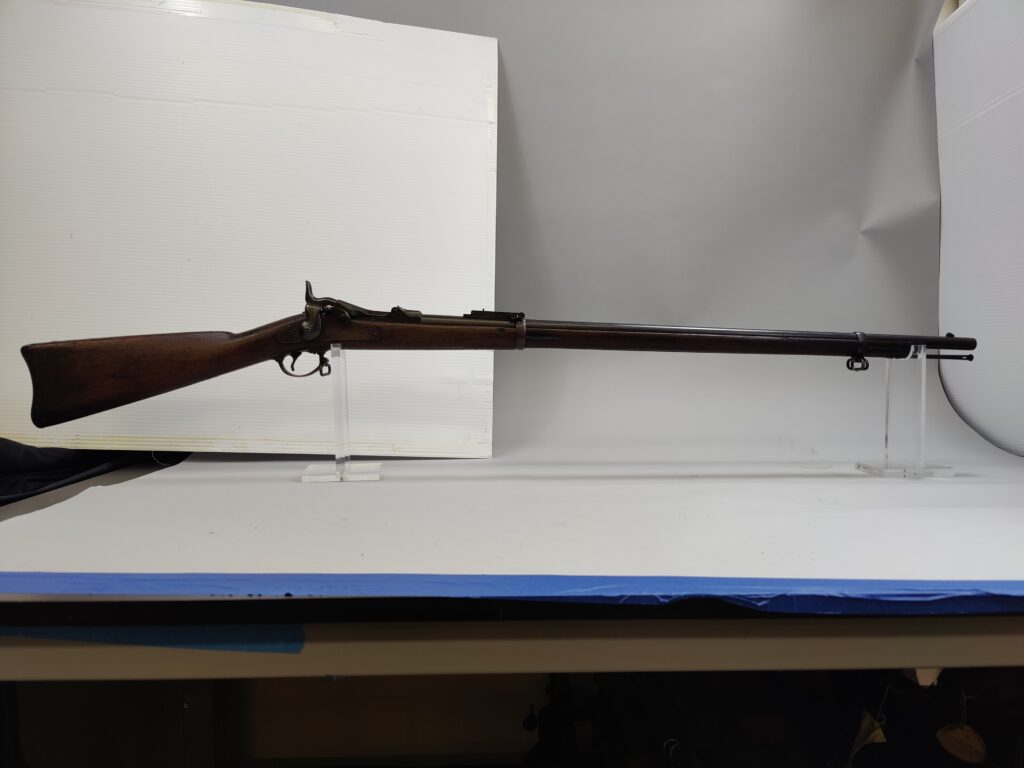
Weight: 8 lb. 8 oz. (approx.)
Overall Length: 51 1/2”
Barrel Length: 31 1/8”
Chambering: .45-70
Feed System: single-shot breechloader
Operating System: single-shot, hinged breechblock
Rate of Fire: 15 rounds per minute (approx.)
Range: 1,200 yd effective (volley fire, area target);
600 yd effective (point target)
Description
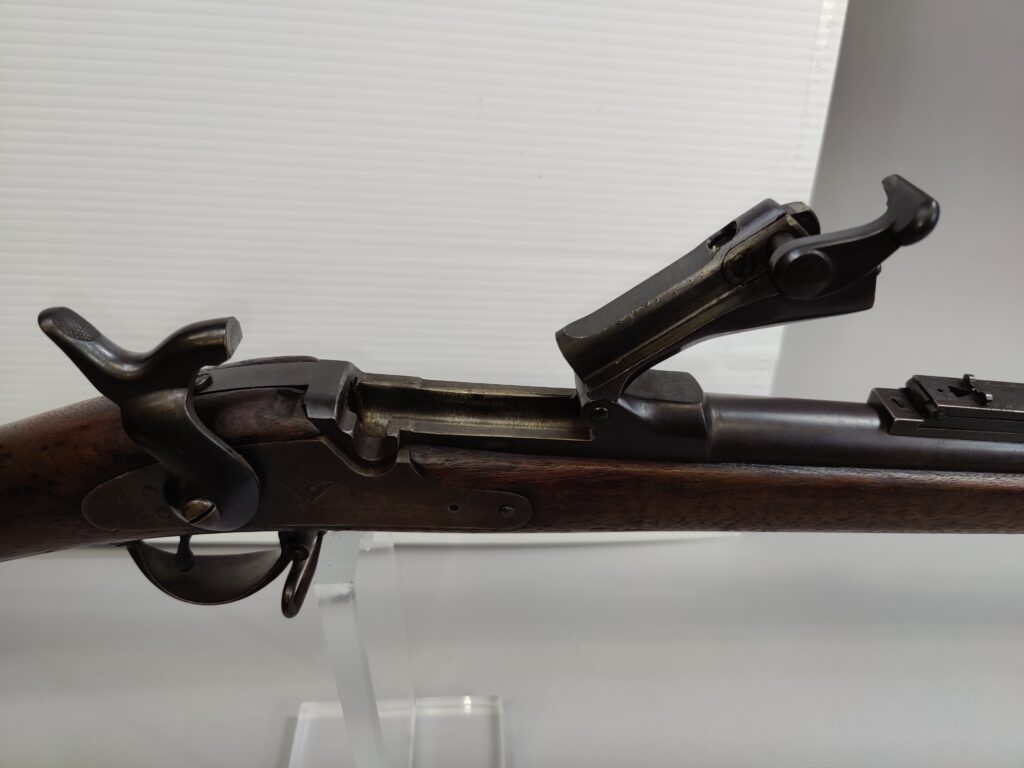
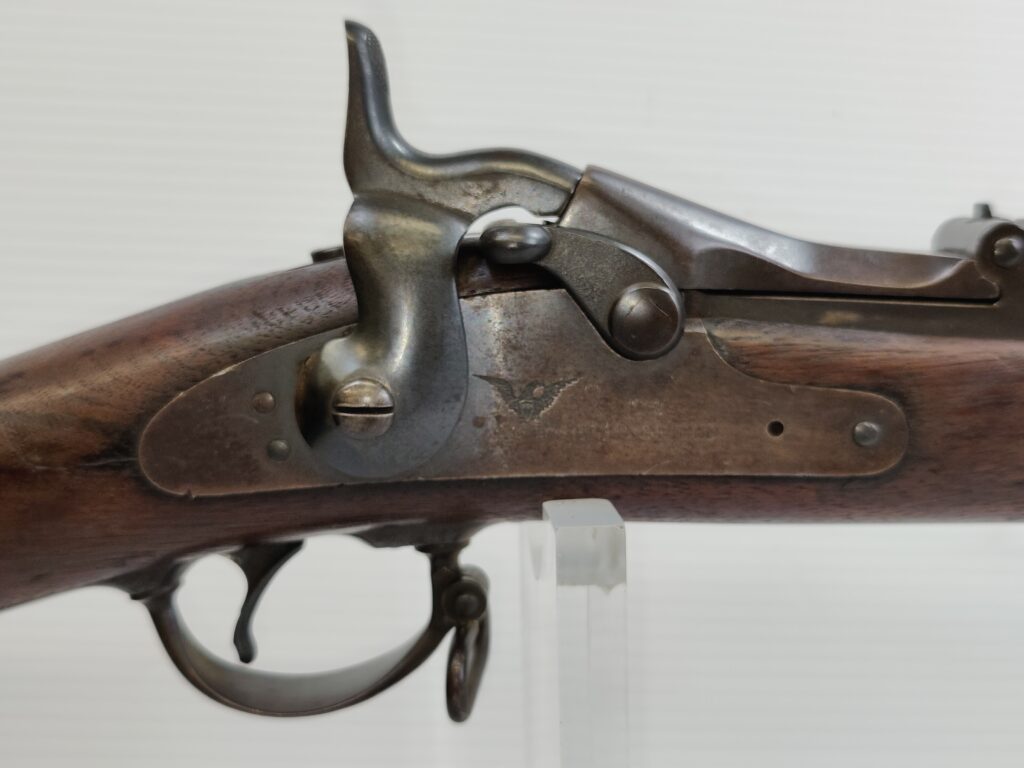
The “trapdoor Springfield” takes its colorful nickname from its distinctive hinged breechblock, which opens upward just like a trapdoor to expose the chamber. To load the rifle, the shooter opens a latch on the right side to unlock the breechblock so it can be opened. With the chamber exposed, the shooter then inserts a single cartridge, closes and locks the breech and cocks the hammer.
After firing, the shooter must manually extract the spent casing, as no mechanical extractor or ejector is present on this design. Stuck cases were a common problem before harder brass cartridge cases were available, contributing to the 7th U.S. Cavalry’s annihilation at the Battle of Little Bighorn. Indeed, 2nd Lieutenant H.K. Gilman’s 1885 “Marines’ Manual” advises to “always withdraw the empty case at once, never allow it to remain in the chamber, as it is apt to corrode and stick fast if left there.”
Development and Service History
Beginning in 1865, Springfield Armory master armorer Erskine S. Allin developed a series of retrofits for Civil War surplus .58-caliber rifle-muskets to convert them to breechloaders. Allin’s system replaced a muzzleloader’s solid breech with a hinged breechblock that could tilt up to allow a metallic cartridge to be loaded directly into the chamber. Early Allin conversions used a .58-caliber rimfire cartridge which was quickly replaced with a .50-cal. centerfire cartridge dubbed “.50-70 Government” after its caliber and charge weight in grains of black powder. Allin’s .50-70 Model 1870, though greatly refined over previous conversions, was still found to be lacking in ballistic performance, and so was redesigned for the new .45-70 cartridge. The U.S. Army formally adopted the Allin rifle in .45-70 and cavalry carbine in .45-55 as the M1873 rifle and carbine, respectively.
Though heavily used by the Army on the western frontier, the M1873 rifle also made its way around the world in the hands of Marine riflemen beginning in 1878. Along with its improved M1884 variant, Marines used the “trapdoor Springfield” along with much smaller numbers of the Navy’s M1885 Remington-Lee in various expeditionary actions throughout the 1880s and early 1890s. Military technology was advancing rapidly in the late 19th century, however, and with the invention of smokeless powder by French scientist Paul Vieille in the 1880s, the large-caliber, low-velocity .45-70 cartridge became obsolete. By the outbreak of the Spanish-American War in 1898, Marines in the fleet were already using the M1895 Lee Navy, a thoroughly modern magazine-fed repeating rifle firing a small-caliber, high-velocity 6 mm round.
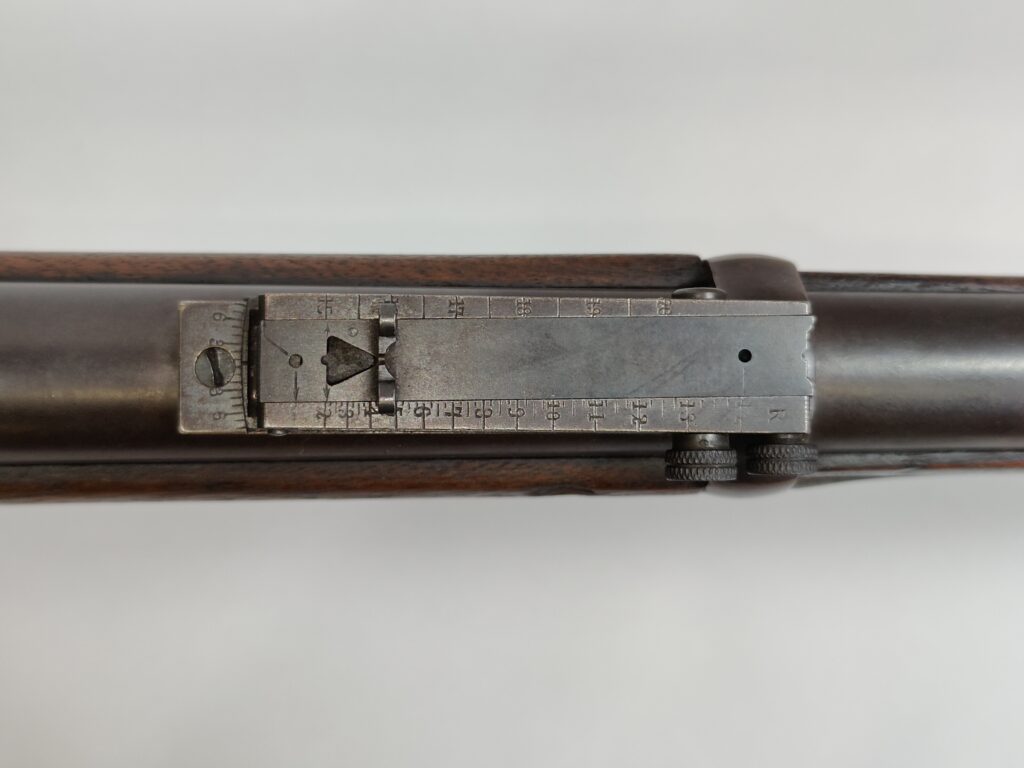
rear sight.